The Process IS the Product: A Conversation with Raffi Garabedian
How Electric Hydrogen's CEO is applying First Solar's cost-curve playbook to build the US industrial base — and why the hardest part isn't the technology
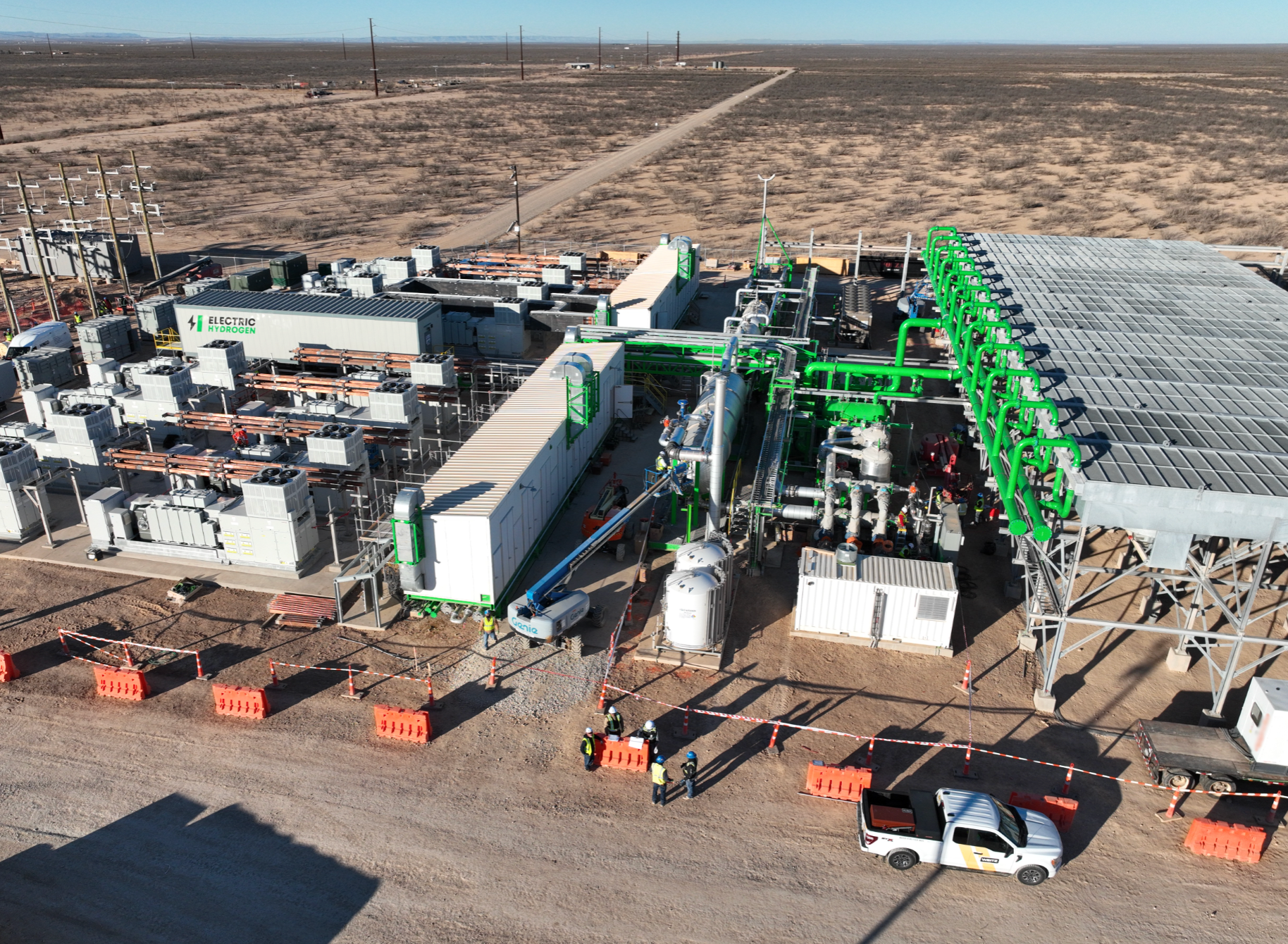
Electric Hydrogen’s first plant in commissioning, a 100-megawatt electrolysis facility in Pecos, Texas, supplying Infinium's eSAF operation in what will be the largest sustainable aviation fuel plant in the world.
Most founders in advanced manufacturing will tell you their breakthrough is their technology — the novel chemistry, the proprietary membrane, the advanced material. Raffi Garabedian will tell you they're wrong. Or at least, they're missing the point.
Garabedian would know. As the former CTO of First Solar, Garabedian helped drive one of the most dramatic cost reductions in energy history, taking thin-film solar from niche curiosity to global commodity. The lesson he took from that experience wasn't about photovoltaics. It was about process. "The product — a thin-film solar module — is not the magic," he told us. "The magic is how can you make it." It's a deceptively simple insight, and it's now the operating philosophy behind Electric Hydrogen, the company he co-founded to bring industrial-scale green hydrogen to market.
Electric Hydrogen is commissioning its first commercial plant right now — a 100-megawatt electrolysis facility in Pecos, Texas, for Infinium's eSAF operation in what will be the largest sustainable aviation fuel plant in the world when it comes online. The project is valued at roughly $350 million, project-financed by Brookfield and HSBC. It is, by any measure, a big bet. And it was designed to be.
We sat down with Garabedian to understand why he chose to go big when conventional wisdom said start small, how he's building a manufacturing culture that defies American industrial orthodoxy, and what the rest of the advanced manufacturing ecosystem can learn from a CEO who believes the factory floor is where the real innovation happens.
Milo Werner: You're commissioning your first commercial plant right now. Where does that put you in the commercialization journey?
Raffi Garabedian: We're right in the thick of it. The plant in Pecos, Texas is our first full-scale commercial facility — 100 megawatts of electrolysis. We're building the plant now, testing it in Q1, and we'll be ramping it up the rest of the year in preparation for our customer’s start of commercial operations.
The core technology we manufacture are the stacks, and those are made at our facility in Devens, Massachusetts. The rest of the plant — power conversion equipment, fluid systems — that's our design, vertically integrated down to shop drawings, but fabricated by partners in the oil and gas supply chain. So we control the design of the full system, but we're strategic about what we build ourselves versus what we contract out.
You made a conscious decision to build at massive scale from the start — 10-megawatt stacks when the industry norm was 100 kilowatts. Walk us through that decision.
Raffi Garabedian: It was absolutely conscious. When we started the company five years ago, electrolysis wasn't new. Plenty of people make kilowatt-scale or 100-kilowatt-scale electrolyzers for small industrial and scientific markets. That's a fine business. But the market we wanted to serve was deep industrial decarbonization — ammonia production, sustainable fuels, steel — and the natural scale of those operations is hundreds of megawatts to gigawatts.
We did the fundamental cost workup, and you just can't get green hydrogen cheap enough with 100-kilowatt modules. Too many parts, too many pieces. It's unscalable and operationally impractical at that size. So we designed the product to fit the market we wanted to help create. And then we had to overcome the constraints — one of them being that nobody had ever banked an electrolyzer at this scale before.
If we had taken a different path and brought a small product to market first, we would probably still be at that scale. We wouldn't be in deep industrial decarbonization at all. That's not a practical pathway for a venture-financed startup. You'd run out of time and money before you ever got to the market that matters.
That raises the question: how do you convince investors to finance something nobody's built before? How did you solve bankability?
Raffi Garabedian: Getting to bankability has been our most significant commercialization challenge. This is a product that costs roughly $100 million, connected to a project that costs $300 million. How do you get project-level investors comfortable with new technology risk?
We used the same playbook I learned in solar. You build the reliability story from the ground up — fundamental failure physics, accelerated life testing, failure mode analysis, then scale-up testing and racking up hours. But you do it in concert with a credible third party. In our case, we used DNV, which is one of the most respected independent engineering firms in energy. Together, we built the reliability case that gets you to bankability.
It was very expensive. Testing a 10-megawatt stack costs a lot of money just in power and infrastructure. We built a pilot facility in San Jose on balance sheet specifically to do this. It's incredibly hard to do unless you're very well financed, and it's one of the reasons this scale of hardware is so difficult to bring to market. But there's no shortcut. Investors need to see the data.
You've said that at First Solar, the process was the product. What do you mean by that, and how does it apply to what you're building now?
Raffi Garabedian: At First Solar, the person who ran manufacturing engineering epitomized the conservatism you see in traditional manufacturing — predictability, precision, repeating the same outcome every time. My job as CTO was change. Making the product better. That tension was always intense, and it nearly crippled the company because we held onto the legacy platform for too long. All the reasons — "it's predictable, we know it, we know how to make it."
But what we did really well — and this has always been central to First Solar's survival — is we did the R&D on the manufacturing platform. Why? Because the manufacturing process is the product. A thin-film solar module is not magic. The magic is the process that makes it. And the only way to bring new innovation to market is through process development done at scale, on the manufacturing line, because translating from R&D scale to manufacturing scale is itself a multi-year problem. You can't afford to do it sequentially. You have to dedicate manufacturing resources to R&D.
That's not the way American manufacturers typically think. Last year, Intel finally gave up their mantra of "copy exactly." Meanwhile, Micron always took a pragmatic approach — different tools in different fabs, but make the same device, figure it out. They were scrappy in a way that most semiconductor companies aren't. That kind of adaptability is what process innovation actually looks like.
How do you build a team that can operate this way? You've talked about "athletes versus operators" — what does that mean in practice?
Raffi Garabedian: Invention and core engineering — experience is less important than intellect. To do something new, something radical, you need athletes. People who can do anything, you just point them at a problem and they're going to figure it out.
But industrialization is different. You need experience because you need to see around corners and anticipate the practical problems that will cause you pain. If you think about designing a factory from scratch, intellectually it's not that complicated. The integrated flow of building it and getting it right — that's super hard. It's a complexity problem.
So you need operators who know how to industrialize things. The difficulty is that most of those people — and I say this with all due respect — are conservative. They're not very interested in doing new, exciting, risky things. That's actually what makes them good at manufacturing. If you think about Six Sigma as a discipline, it is fundamentally anti-change.
My rubric is to have a few experienced people at or near the top of the manufacturing organization and then surround them with a bunch of athletes who are smart and innovative. You create this creative tension. The experienced folks get an opportunity to develop people and teach them about manufacturing. But in the process, they're learning too, because they're getting stressed by all these new ideas being forced into their manufacturing process.
You located your manufacturing in Devens, Massachusetts, right next to your R&D facility. That wasn't the obvious choice.
Raffi Garabedian: It wasn't. We went through the whole typical site selection process — low power costs, workforce, incentives. Colorado looked good, Texas looked good. But I'm grateful we got real about it at the end and said, no, it's got to be right next door to our R&D site, because that's where all the process development happens.
Our R&D team is extremely young and creative and talented. No real industrial experience, generally. Those people — those humans — are running the manufacturing line. And that culture of mixing R&D people with manufacturing is where the real innovation comes from.
It's fascinating to watch. We now have a bunch of people in Devens who are manufacturing engineers for all intents and purposes, but they're looking at the problem from a completely different standpoint. They ask questions that a traditional manufacturing person would never ask — "What if I change the materials? What if I rethink this step?" In a typical manufacturing company, leadership wouldn't allow those questions. You'd say, "We have a process, we have an R&D team, we have stage gates." And so you create a wall between R&D and manufacturing that becomes an impediment to innovation.
We can't afford that wall. We can't afford to go slowly if we're going to catch up.
This sounds expensive. You've talked about a "missing middle" of capital for companies at your stage. What needs to change?
Raffi Garabedian: Industrialization requires critical mass. There's no way to do it on a shoestring. Manufacturing takes people, and at industrial scale, the engineering and deployment work is incredibly people-intensive. You have to carry a lot of burn for a significant period while you build the organization and get over the bumps.
A key piece of advice I'd give any founder in this space: build your business around a market that has a lot of momentum to it. You can't solve the technology and scaling risk problem and the market risk problem at the same time. One of them has to feel secure.
But even with strong market pull, there's this middle chunk of capital that's incredibly thin. You're past the venture stage, so now you're dealing with growth-style investors who want certainty. They're low risk, low reward. A single loss is a career ender for those fund managers.
If you look at what happened in China with solar — all the early Chinese solar manufacturers are gone. Roughly $60 billion of government-backed capital just disappeared. But out of those ashes grew the companies that now dominate the global solar industry. We can't repeat that model. No private investor is going to sign up to subsidize the next winner. It's the opposite of the VC model.
I think the VC model is critical — it's the American way to fund this, and it produces more innovative, more game-changing outcomes. But we need more risk-forward capital in that middle ground. And that's maybe where government should play a role, which honestly is a little scary to me. But the alternative is watching this opportunity move overseas.
The Underscore
What Garabedian is building at Electric Hydrogen represents a test case for a thesis that the entire advanced manufacturing ecosystem is wrestling with: Can the United States compete in industrial hardware not just by inventing better technology, but by mastering the process of making it? His answer — that the process is the product, that R&D and manufacturing must be inseparable, that you need athletes and operators in creative tension on the same factory floor — offers a playbook that extends well beyond hydrogen.
This is the first in our "Not Your Father's Factory Floor" series, where we profile the leaders building the next generation of American manufacturing. Raffi is blunt about the difficulty of what he's attempting. But he's equally clear about the stakes: "We can't afford to go slowly if we're going to catch up."
What lessons from your own manufacturing journey echo Raffi's experience? Join the conversation in the NextGen community.